Gongfu vs Western Tea Brewing: Ratios and Rhythm
- Two ratio systems, many traditions
- “Gongfu” is more than a small pot
- Western-style brewing prioritizes one full cup
- Gongfu-style brewing separates the leaf's changes
- Pick a vessel you can pour safely
- Weigh leaf because volume lies charmingly
- Temperature remains tea-specific
- Short time requires a complete pour
- Rinsing is optional and contextual
- A sample oolong comparison
- Which method uses less tea?
- Caffeine cannot be inferred from the vessel name
- Wet leaves need a continuous session
- Choose by the experience you want
Two ratio systems, many traditions
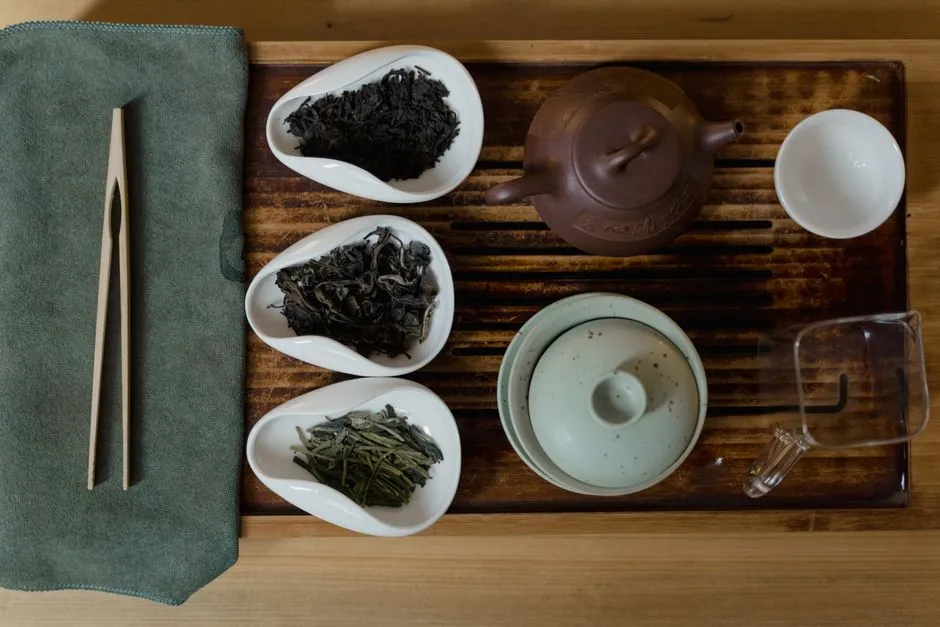
Western-style tea brewing usually means a modest amount of leaf in a mug or pot for one longer infusion. Gongfu-style brewing uses much more leaf per millilitre in a small gaiwan or teapot, then makes a sequence of short infusions.
As a starting comparison:
| Variable | Western-style | Gongfu-style |
|---|---|---|
| Leaf | 2.5–3 g | 5–8 g |
| Water | 250 mL | 100 mL |
| Infusion | One longer steep, commonly 2–5 minutes | A sequence of short steeps measured in seconds |
| Vessel | Mug or larger pot | Small gaiwan or teapot |
| Experience | One integrated cup | Changing aroma and flavor across repeated infusions |
At 3 g per 250 mL, the ratio is 1.2 g per 100 mL. A 6 g gongfu session in 100 mL therefore uses five times that leaf concentration: 6 ÷ 1.2 = 5. |
That does not mean five times the caffeine in each cup or five times the superiority. Total water, infusions, extraction, and what you actually drink all matter.
“Gongfu” is more than a small pot
Gongfu cha has histories and living practices associated especially with Chinese tea cultures, with regional, family, commercial, and contemporary variations. A beginner using a gaiwan for repeated short infusions is exploring a brewing format, not automatically performing a complete ceremony.
Describe the method precisely. Learn cultural practice from knowledgeable practitioners and primary cultural sources. Do not purchase six tiny cups and appoint the coffee table ambassador to all Chinese tea.
This guide compares controllable variables—leaf, water, time, vessel, and pours—without claiming authority over etiquette or lineage.
Western-style brewing prioritizes one full cup
For a 250 mL mug, weigh 2.5–3 g leaf. Use the maker's temperature and time. Remove or strain leaves when the infusion reaches the desired strength.
Advantages include:
- simple equipment;
- one familiar serving size;
- easy brewing at a desk or breakfast table;
- fewer pours; and
- straightforward additions such as milk when appropriate.
The longer infusion integrates early and later extraction into one cup. That can be convenient and balanced, but an overlong steep may become harsh.
A basket infuser large enough for leaves to open works better than a cramped tea ball for many whole-leaf teas. The infuser should be easy to remove without redecorating the desk in wet oolong.
Gongfu-style brewing separates the leaf's changes
Use a 100–150 mL gaiwan or small pot. Weigh 5–8 g leaf per 100 mL as a broad starting range, then follow the specific tea.
Add water, cover, and decant completely after a brief infusion—perhaps 10–30 seconds for the first steep, depending on leaf and temperature. Repeat, lengthening time as flavour fades.
Advantages include:
- tasting changes across infusions;
- adjusting after every small cup;
- concentrated aroma;
- sharing several rounds; and
- giving rolled or compressed leaves room to open progressively.
The method requires attention and safe handling. Small vessels cool quickly but can also burn fingers when overfilled.
Pick a vessel you can pour safely
A gaiwan is a lidded bowl, often with a saucer. Practise its grip using cool water. Hold the rim rather than the hot body, keep the lid slightly offset to strain leaves, and pour away from fingers and guests.
A small side-handle or rear-handle teapot may feel easier. Vessel material affects heat retention: thin porcelain responds quickly; thick clay retains more heat. Clay can also absorb aroma, so learn its care before assigning one pot to every tea in the cupboard.
Do not fill to the brim. A useful vessel volume is the amount you can decant confidently, not the manufacturer's optimistic geometric capacity.
Weigh leaf because volume lies charmingly
Six grams of dense rolled oolong occupies far less space than six grams of broad white-tea leaf. A tablespoon is not a stable ratio across shapes.
Use a scale reading to 0.1 g. Weigh the dry vessel, tare, add leaf, and record it. If a scale is unavailable, use the producer's spoon guidance for that specific tea rather than one universal “teaspoon.”
For a first session, try 6 g in a 100 mL vessel. If infusions are overwhelming even at very short time, reduce to 5 g. If thin, add leaf next session rather than extending the first infusion into a small hostage situation.
Temperature remains tea-specific
High ratio does not eliminate temperature. Use the tea brewing temperature guide and the leaf maker's directions.
Greener oolong may begin around 85–95°C/185–203°F; roasted or darker oolong often uses 90–100°C/194–212°F. Delicate green tea may use cooler water. A compressed dark tea may use boiling water.
Preheat the small vessel if the tea needs high temperature: fill with hot water, swirl safely, and discard before adding leaf. This also warms cups. Skip preheating when it makes the setup unsafe or the tea deliberately uses cool water.
Short time requires a complete pour
Start the timer when water meets leaf. Decant all liquor when time ends. Leaving a little water in the vessel continues extraction and makes the next infusion inconsistent.
If serving several cups, pour into a fairness pitcher first so the infusion has one strength. Without a pitcher, alternate small pours among cups until empty. This is sometimes called distributing in rounds.
For one person, pour directly into a cup large enough to hold the entire vessel. A 100 mL gaiwan and a 60 mL cup create an avoidable hot-liquid logistics exercise.
Rinsing is optional and contextual
A quick rinse may warm leaves, begin opening compressed tea, or remove surface dust. It also discards extracted aroma and is not a sterilization method.
Follow guidance for the tea. Delicate green and white teas are often not rinsed because the first extraction is valuable. Compressed or aged tea may receive a brief rinse in some practices.
If rinsing, pour hot water on, decant immediately, and discard safely. Do not drink a rinse you intended to discard because it suddenly smells expensive.
A sample oolong comparison
For Western style:
- Weigh 3 g oolong.
- Use 250 mL water at 90°C/194°F.
- Steep 3 minutes.
- Strain completely.
For gongfu style:
- Weigh 6 g of the same tea.
- Use a 100 mL vessel and 90°C/194°F water.
- Try 20 seconds, then 25, 35, 50, and 75 seconds.
- Decant completely each time.
These are experiment settings, not a claim that the tea wants them. Compare aroma, texture, bitterness, aftertaste, and how the leaf opens.
The Western cup uses 3 g across 250 mL. Five gongfu infusions use up to 500 mL total water with 6 g leaf. Comparing one 100 mL cup with the whole 250 mL mug would compare moments, not sessions.
Which method uses less tea?
Western style uses fewer grams per brew, but gongfu-style leaves may produce more separate infusions. Cost per millilitre depends on grams, purchase price, total water, and which infusions you enjoy.
Calculate:
session leaf cost = package price ÷ package grams × grams used
A $20 package containing 100 g costs $0.20 per gram. A 3 g Western brew costs $0.60 in leaf; a 6 g gongfu session costs $1.20. This arithmetic says nothing about value unless you also count satisfying cups.
Prices vary; the numbers are an example, not a market claim.
Caffeine cannot be inferred from the vessel name
Higher leaf ratio can extract substantial caffeine, while repeated infusions continue extraction. Temperature, time, leaf material, processing, and total liquid consumed matter.
Do not assume tiny cups mean a low-caffeine session. If caffeine affects sleep, anxiety, pregnancy, medication, or a health condition, consider all sources and seek individual professional advice. A decaffeinated labelled product is more dependable than attempting to rinse caffeine away.
Wet leaves need a continuous session
Between infusions, leave the lid ajar so heat and steam can escape when appropriate. Resume within a continuous session. Do not leave warm wet leaves at room temperature from breakfast to evening.
Wet plant material is perishable. When the session ends, discard or compost leaves where accepted, wash the vessel, and dry it fully. Do not return brewed leaves to the dry-tea container, which would be an unusually efficient way to introduce moisture.
For dry-leaf protection, see how to store loose-leaf tea.
Choose by the experience you want
Use Western style when you want one mug, minimal equipment, milk, or easy repeatability. Use gongfu-style brewing when you want to observe several infusions, adjust in small steps, or share concentrated cups.
Either method can support the five-minute tea mindfulness practice, though a kettle, gaiwan, pitcher, tray, timer, scale, and eight pours may exceed the plain meaning of five.
Neither method rescues stale leaf, poor water, or inattentive timing by cultural prestige. Measure honestly, pour safely, and call the method what it is. The best brewing style is the one that lets this tea taste interesting without asking borrowed ritual to do the flavour's work.